The temperature hours ago climbed past 104 degrees, and the taxi’s air-conditioning is struggling to keep up. We are barreling across the lush plains of Uzbekistan on a midsummer afternoon. Then, suddenly, we climb into rugged hills, and the driver rolls down his window, sending a blast of baking-hot air into my face. But as we roar up hairpin turns, past vacation chalets, hotels and a pedestrian bridge spanning a deep and narrow canyon, a delicious cool replaces the searing heat.
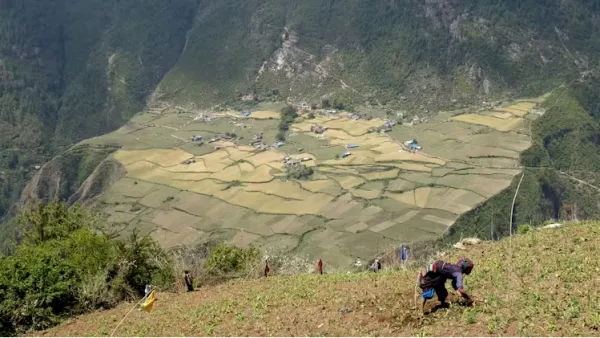
By the time the pavement gives way to gravel, we are traveling through a landscape resembling crumpled paper. Lonely stands of juniper dot the chaotic jumble of sharp mountain slopes. To the south, flecks of snow glint off the jagged peaks of the Turkestan Range. The only sign of human life is a distant cowboy trotting alongside a herd of cattle.
From a treeless ridgeline road we turn onto a narrow track that plunges into a vertiginous valley. Horses graze along a stream trickling down the steep incline. Soon we pull up beside three shipping containers, placed in a “U” shape, that form the base for an international team of some two dozen archaeologists. In its shaded courtyard, three young volunteers are squatting over blue plastic tubs, washing plain brown pottery shards that were once vessels used by residents of a long-lost settlement that dates to the heyday of the fabled Silk Road.
One of the volunteers points to a dirt path that vanishes around a bend. Beyond it is an open meadow that rises to a knoll perched above two streams that merge far beneath. The sun is low in the west by the time I reach the top and take in the spectacular view. Some 20 workers, meanwhile, labor with brushes and trowels in an open excavation pit the size of a modest modern home’s foundation—a discovery unexpected for such high altitudes.
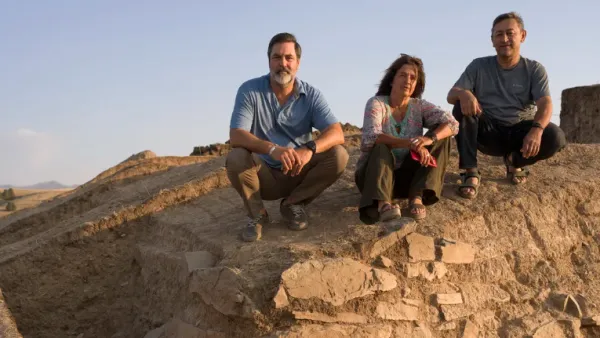
“This place doesn’t make any sense,” says Michael Frachetti, an archaeologist at Washington University in St. Louis, stepping back from the lip of the trench as a man in dusty khakis trundles by with a wheelbarrow filled with earth. Frachetti co-directs the dig of Tugunbulak, as the vast area is known, with Farhod Maksudov, who leads Uzbekistan’s National Center of Archaeology, in Tashkent, and Sanjyot Mehendale from the University of California, Berkeley. Frachetti gestures to the nearby hills, pointing to faint straight lines and right angles—tantalizing hints of ancient structures—highlighted in the evening’s slanting sunlight. “This was so monumental—the whole valley is one big archaeological site.”
The sole inhabitants of the area are roving shepherds, only a couple of whom stay to brave the harsh winters, as well as a few farmers who come to cultivate fields in the summer. A thousand years ago, however, impressive walls interspersed with formidable towers enclosed some 300 acres, about twice the size of Pompeii. Yet this site lies at around 7,000 feet above sea level, where a June snowstorm is not unusual and the snowpack can last for more than half the year. Even today, few humans live year-round at such an unforgiving altitude.
Climbing out of the trench, Maksudov picks up a football-size chunk of rock from a large pile. “Here, hold this,” he says, laughing when my face betrays surprise at its heft. “It weighs so much because of the iron pellets inside,” he explains, pointing to the stone’s crimson striations. Miners, smelters and blacksmiths may have converged at this remote site as early as the sixth century A.D. to produce the weapons and tools indispensable for medieval Central Asia. They likely forged swords, arrow tips and horse tack essential to all the great steppe empires, including the Scythians, Huns and Mongols, and presumably made hoes and plows that helped transform marshy lowland oases into productive farmland. These wares radiated out along a shifting network circulating goods, technologies and faiths from Manchuria to the Mediterranean, and from Sri Lanka to Siberia, a network that Ferdinand von Richthofen, a 19th-century German geographer, first described as the Silk Road.
The detection of a medieval industrial town at high altitude, the fruit of three years of research using high-tech drones and low-tech shovels, is generating excitement among Central Asia specialists all over the world. “To find a city-sized settlement in this highland landscape is entirely a surprise,” Søren Michael Sindbæk of Denmark’s Aarhus University told me when the discovery was reported last year.
The excavation’s leaders are convinced, even as they still are analyzing historical and archaeological data, that the mysterious urban area is the long-lost city of Marsmanda, an iron-producing metro-polis mentioned in tenth-century Arab sources, but which has never been located. It’s a reasonable claim, according to many of their colleagues. More broadly, the discovery lends weight to fresh thinking about how the Silk Road emerged and evolved before sea routes diminished its traffic after the 15th century. The pastoralists who roamed the Central Asian uplands have long been cast as marginal outsiders or mounted predators, ready to swoop down on vulnerable lowland populations. Tugunbulak’s sophistication, however, suggests instead that the region’s mountain residents were an essential part of the lucrative web that came to be called the Silk Road.